Runnymede St Edward's Catholic Primary School
Curriculum
Curriculum Intent
Curriculum Intent
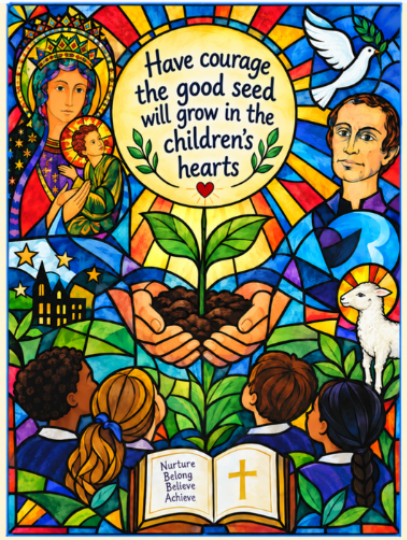
Our Mission ‘Have Courage the Good Seed Will Grow in the Children's Hearts'
At Runnymede St Edward’s Catholic Primary School, we are a strong Christian community committed to inspiring and challenging every child to fulfil their God-given potential and strive for excellence. Our curriculum is underpinned by high expectations for all pupils, regardless of background, and a strong commitment to equity, inclusion, and closing gaps for disadvantaged pupils and those with SEND.
We aim to develop curious, resilient and independent learners with enquiring minds who question, think critically and deepen understanding rather than simply accept information. Learning is carefully sequenced from EYFS through KS1 and KS2, ensuring clear progression and purposeful links that build securely on prior knowledge. We place strong emphasis on long-term memory and mastery so that learning is remembered and applied over time.
Oracy and vocabulary development are central to our curriculum, supporting strong communication, reading and comprehension skills across all subjects. We ensure full coverage of the National Curriculum, enriched with opportunities for creativity through the arts, music and drama, alongside a strong focus on physical development and wellbeing through PE and PSHE.
At the heart of all we do are the 8 Essentials of Edmund Rice Education, which underpin our mission and shape every aspect of school life. These essentials guide us in growing together as a school community and in responding compassionately to the needs of those we serve. They ensure that our curriculum is rooted in Gospel values and lived through daily experience. In particular, we strive to:
- Nurture faith and spiritual growth, helping children develop a personal relationship with God and live out Gospel values in their everyday lives.
- Create inclusive and welcoming communities where every child is valued, respected and supported to flourish.
- Promote justice and solidarity, encouraging pupils to recognise inequality and respond with compassion and action.
- Encourage high expectations and excellence, enabling all learners to achieve their full potential academically, socially and personally.
- Foster holistic development, ensuring children grow morally, spiritually, socially, culturally and intellectually.
- Build strong relationships based on respect and care, where mutual understanding and kindness are at the centre of school life.
- Develop global awareness and responsibility, helping pupils understand their role as citizens in modern Britain and the wider world.
- Encourage active participation and stewardship, empowering children to use their gifts to make a positive difference in their communities.
Through this, we prepare our pupils to be confident, compassionate and responsible citizens of modern Britain, with open hearts and minds, a strong sense of identity, and a commitment to making a positive difference in their communities and beyond.
Curriculum Implementation
Curriculum Implementation
We follow the aims of the National Curriculum, which provides pupils with the essential knowledge they need to become educated citizens. It introduces children to the best that has been thought and said, developing an appreciation of human creativity, achievement and the world around them.
At Runnymede St Edward’s Catholic Primary School, our curriculum is rooted in our Catholic faith and carefully designed to meet the needs of our children. We recognise that the National Curriculum provides the foundation for learning, while our wider school curriculum offers opportunities to enrich pupils’ experiences, develop their talents and nurture their spiritual, moral, social and cultural development.
Our curriculum is ambitious, broad and balanced, with carefully sequenced learning that enables pupils to build knowledge, understanding, skills and vocabulary over time. Subject leaders' curriculum overviews and progression documents identify the essential knowledge and skills pupils need to acquire at each stage of their education. Meaningful connections are made between subjects where appropriate, while maintaining the distinct knowledge and disciplinary understanding of each subject.
Clear curriculum end points identify what pupils should know and be able to do by the end of each year group. Teachers build upon prior learning through explicit teaching, regular retrieval, revisiting key concepts and opportunities to apply knowledge in meaningful contexts. These approaches support pupils in remembering more over time and developing secure foundations for future learning.
We are committed to providing an inclusive and ambitious curriculum for all pupils, including those with special educational needs and disabilities (SEND) and disadvantaged pupils. Teaching is carefully adapted, where necessary, to ensure that all children can access the curriculum, develop their knowledge and achieve their potential.
We believe that education extends beyond academic achievement. Through rich learning experiences, opportunities for personal development and high expectations, we aim to raise aspirations, develop confidence and prepare our children to contribute positively to the wider world.
The Eight Essentials of Edmund Rice are woven throughout our curriculum, supporting the development of the whole child. Rooted in our Catholic values, we nurture children to grow in faith, wisdom, compassion and responsibility, developing a strong understanding of their relationships with God, others and the world around them.
Our school mission, “Have courage, do good, seed will grow in the children’s hearts,” underpins our approach to education, inspiring children to live out their faith through their words, choices and actions.
Curriculum Impact
Curriculum Impact
At Runnymede St Edward’s Catholic Primary School, we evaluate the impact of our curriculum by considering how well pupils know, remember and can apply the essential knowledge, skills and vocabulary they have been taught.
Our carefully sequenced curriculum, from EYFS to Year 6, identifies clear learning expectations and end points for each subject. Teachers use ongoing formative assessment, retrieval activities, questioning and end-of-unit assessments to evaluate pupils’ understanding, identify misconceptions and establish how securely knowledge has been retained.
Assessment is used purposefully to inform future teaching. Where gaps in knowledge are identified, teachers revisit and consolidate learning to ensure pupils develop secure foundations on which to build new knowledge.
Subject leaders and senior leaders evaluate curriculum impact through a planned programme of monitoring, including lesson visits, book scrutiny, pupil voice, assessment information and discussions with staff. Particular attention is given to how well pupils, including those with SEND and disadvantaged pupils, access the curriculum, acquire essential knowledge and make progress from their starting points.
Pupil voice provides valuable opportunities to explore what children know and remember, how confidently they use subject-specific vocabulary and whether they can make connections between current and previous learning.
Findings from monitoring and assessment inform subject action plans, curriculum refinements and professional development, ensuring that our curriculum continues to meet the needs of all pupils.
Ultimately, we aim for our pupils to leave Runnymede St Edward’s as confident, knowledgeable and compassionate individuals who are well prepared for the next stage of their education and inspired to live out our Catholic values in their everyday lives.